Structure is the spine of every Google Ads account. Get it right and you can read performance in 30 seconds. Get it wrong and even good optimisation work gets buried under reporting noise.
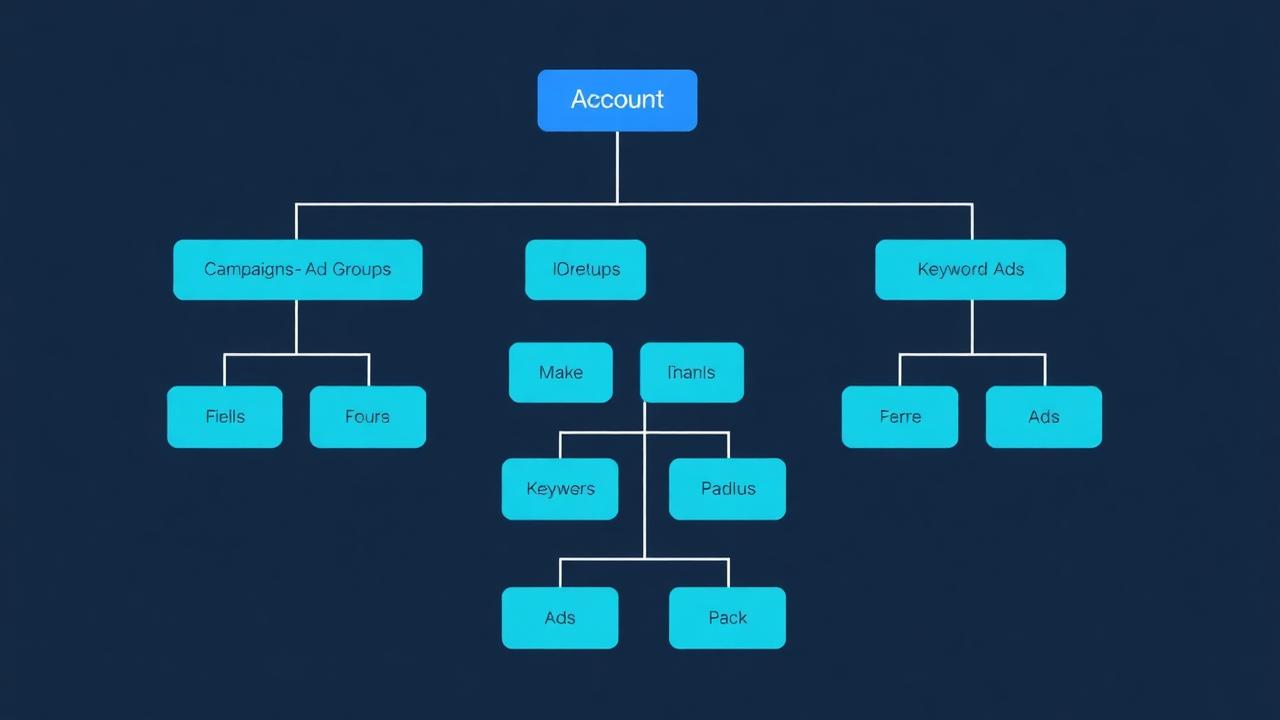
The hierarchy
- Account - billing, users, conversion actions.
- Campaign - budget, location, network, bid strategy.
- Ad group - one tightly themed topic with keywords + ads.
- Ad - the creative.
- Keyword - the trigger plus match type and negative.
Why structure affects control and relevance
Bid strategies operate at the campaign level. Quality Score is calculated at the keyword-ad-landing page triplet. Sloppy ad groups force ads to serve against unrelated keywords - that drops Quality Score and raises CPC for every keyword in the group.
Brand vs non-brand separation
Always run brand in its own campaign. It converts at a different rate, costs a different CPC, and should never share budget with prospecting campaigns. Combining the two makes blended CPA look great while hiding the truth on cold traffic.
Network separation
Each campaign type behaves differently and needs its own campaign:
- Search - keyword-triggered.
- Shopping - product-feed-triggered.
- Display - audience-triggered.
- Performance Max - audience + signal + asset-group triggered.
- Video / YouTube - placement + audience.
Never let Search "include Display partners" - that is a separate auction with a separate logic, and the data pollution is severe.
Campaign budget control
One budget per campaign. If two campaigns must share budget for cash-flow reasons, use a shared budget so neither starves silently.
Ad group theme rule
The simplest rule that works: every keyword in an ad group should be answerable by the same ad headline and the same landing page. If you have to write three different ads to cover the keywords, split the group.
Match type structure
I avoid pure single-match-type ad groups in modern accounts. The Google algorithm now blurs the line between phrase and exact heavily. Instead:
- Use phrase + exact in the same ad group, scoped by theme.
- Avoid broad until you have a deep negative list and Smart Bidding.
Negative keyword lists
Maintain at least three negative lists at the account level:
- Universal negatives - jobs, free, salary, course, download.
- Brand-protection negatives - exclude brand terms from prospecting campaigns.
- Vertical negatives - vertical-specific noise (e.g. "rent" for sales-only real-estate).
Location separation
Different markets behave differently. If you serve both Tier-1 and Tier-2 cities, split the campaign or at least use bid adjustments by location. Reporting becomes useful instead of averaged into noise.
Conversion-goal structure
At the account level, set primary vs secondary conversion actions deliberately. Smart Bidding optimises only against primary goals - if you mark every action primary, you optimise for nothing in particular.
Smart Bidding and data consolidation
Smart Bidding learns better when conversion data is consolidated. Don't fragment campaigns so finely that each gets <15 conversions/month. If splitting hurts data volume, consolidate or use portfolio bid strategies.
Performance Max asset group structure
Asset groups inside PMax behave like mini-campaigns. Build them by:
- Product category - one asset group per product category for e-commerce.
- Service line - one per service for lead-gen.
- Audience signal - layered, not the only differentiator.
Avoid one giant asset group with everything in it - that defeats the point of asset groups.
Small-business example
Illustrative. A Pune dental clinic with ₹40K/month budget might run:
- Brand (clinic name) - ₹3K
- Service: dental implants - ₹15K
- Service: orthodontics - ₹10K
- Service: general checkup - ₹7K
- Call-only campaign for "emergency" terms - ₹5K
E-commerce example
Illustrative. A D2C apparel brand with ₹3L/month might run:
- Brand Search
- Performance Max - core SKUs
- Performance Max - new launches (separated for control)
- Shopping (Standard) - margin protection set
- Search - non-brand category terms
Audit checklist for account structure
- Brand in its own campaign.
- Search and Display split.
- Performance Max asset groups themed.
- Each ad group has <20 keywords with one shared theme.
- Negative keyword lists applied at account level.
- Primary conversions set deliberately.
- Location settings = "people in" not "interested in".
- No Display partners on Search campaigns.